Integrative Approaches Uncover Diversity of Soil Pseudoscorpions in Hainan
Abstract:
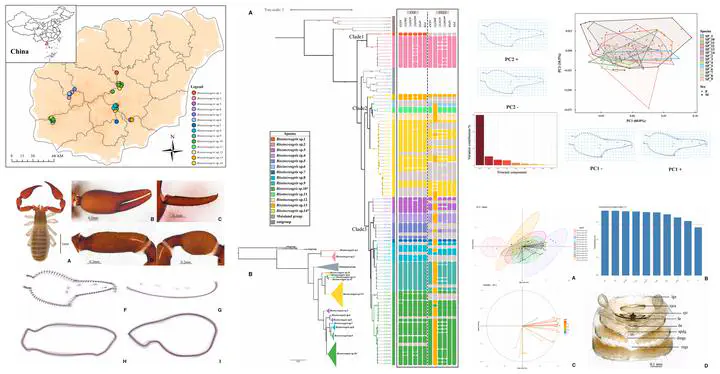
The pseudoscorpion genus Bisetocreagris Ćurčić, 1983 is a relatively common group of soil arthropods throughout Asia, with 81 species reported. Species identification is based on traditional morphological characters, which poses challenges due to their small body size, overlapping distributions, and relatively conservative morphology. In this study, integrative taxonomic methods were used to study over 300 Bisetocreagris specimens from Hainan Island, China, based on both morphological and molecular data. Molecular phylogenetic analyses using mitochondrial (COI) and nuclear (28S rRNA, ITS2, and H3) markers revealed that the putative Bisetocreagris species from Hainan Island do not form a monophyletic group within the genus. Molecular species delimitation analyses using COI and ITS2 genes under 5 methods (ASAP, jMOTU, GMYC, bPTP, and PTP) resulted in the classification of specimens into 8 to 29 distinct species. After re-examining specimens, we ultimately classified them into 12 species and 2 putative species (sp.10 and sp.14) and provided a list of the primary morphological differences among them. The effectiveness of geometric morphometrics, classical morphometrics, and genital morphology in the identification of Bisetocreagris species on Hainan Island is evaluated. This study revealed a higher species diversity of the genus Bisetocreagris than previously recognized and provided a new analytical framework for the taxonomy of Pseudoscorpiones.